
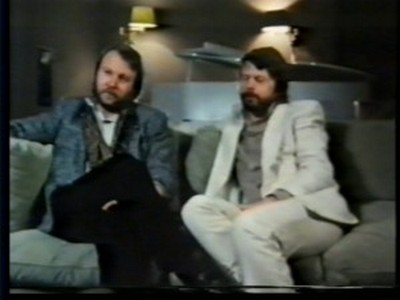
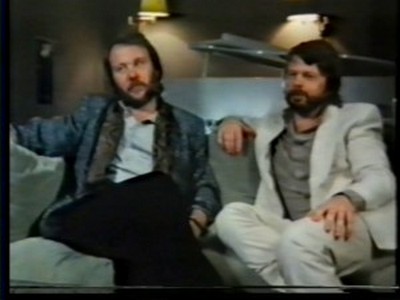
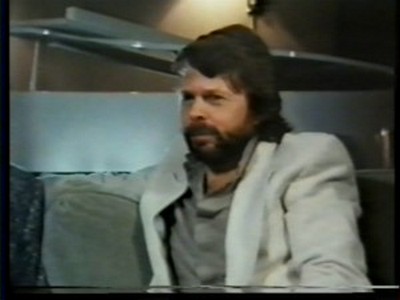
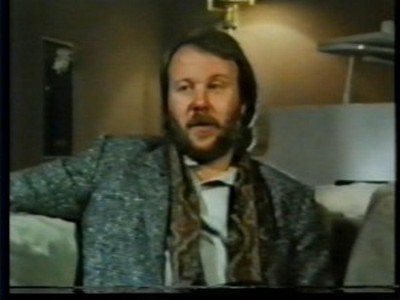
Filmed: late 1984
Location: UK?
Broadcast: Saturday 19 January 1985, 18:00, Channel 4, UK
Release status: Unreleased
Duration: 41:53
Shown in: UK
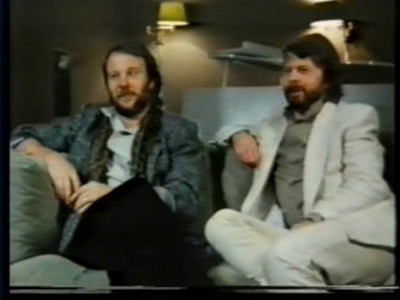
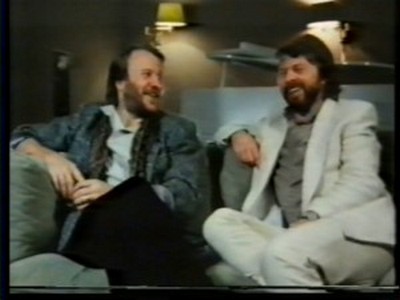
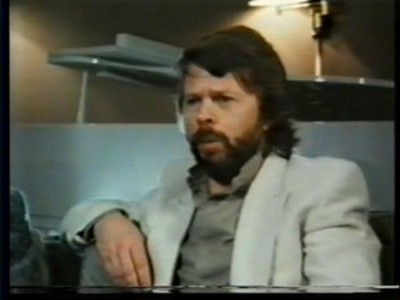
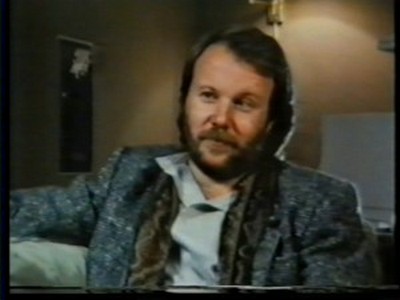
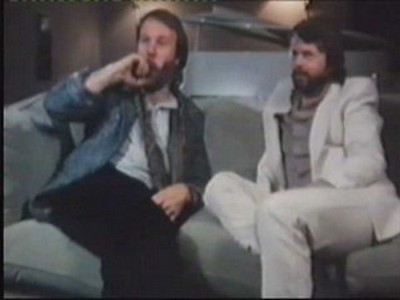
Benny and Björn were interviewed by DJ Paul Gambaccini (although you never see him in the interview, just at the beginning during the introduction). The interview covered their whole career starting with how they met, right up to Chess.
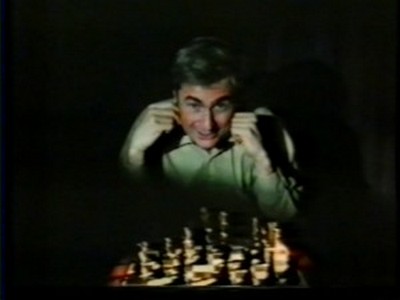
The following clips were shown:
- The Hootenanny Singers - Baby Those Are The Rules - Hemma hos Hootenanny Singers: Larz-Thure Ljungdahl på besök
- The Hep Stars - Sunny Girl
- Ring, Ring PROMO
- Waterloo - Eurovision Song Contest
- Honey, Honey - Spotlight
- I Do, I Do, I Do, I Do, I Do - Made in Sweden for Export
- Fernando - ABBA - The Movie
- Dancing Queen - Det låg ett skimmer över Gustafs dagar
- Mamma Mia - Made in Sweden for Export
- Money, Money, Money PROMO
- Knowing Me, Knowing You PROMO
- Chiquitita - ABBA in Concert
- Gimme! Gimme! Gimme! (A Man After Midnight) PROMO
- Thank You For The Music - ABBA - The Movie
- Take a Chance on Me PROMO
- The Winner Takes It All PROMO
- Super Trouper PROMO
- I Have a Dream - ABBA in Concert
- Elaine Paige - Nobody's Side (PROMO)
- Murray Head - One Night in Bangkok PROMO.
Click here for a TV listing from The Guardian (England) - 19 January 1985, p.28
- Benny during the main title - with his finger in his mouth!
- Benny constantly fiddling with his fingers, touching his hair - very restless. Björn on the other hand hardly moves throughout the whole interview, other than his head and right hand.
Paul Gambaccini (looking over a chess board): It’s looking bad. Here I am check-mated again by Benny Andersson and Björn Ulvaeus who’ve gotten pretty good at this game ever since they collaborated with Time Rice on the musical Chess. It’s a far cry from their native Sweden, where they were big pop stars in the sixties and indeed international favourites in the seventies with ABBA, who had nine number one records in Britain.
PG: If we're to trace your evolution as songwriters up to Chess musical, we should start with your first hit compositions and Björn with you, isn’t that with the Hootenanny Singers with a song called Baby those are the Rules?
Björn: (laughs) Right, you know the story. A very minor hit though, I'm afraid!
PG: Why should a group of teenaged, Swedish young men want to do American folk music?
Björn: Well, unlike Benny, I started in folk. I was in a folk group at school and I don’t know why really, for me that is the way it started. For some people it was rock – for me it was folk. It was, I think, during the Skiffle period which was rather big here as well, that’s where it started and then the Kingston Trio era.
Paul: And you, as with some of Benny’s first songs, writing in English rather than Swedish.
Björn: Yeah, it was very natural, because all the songs we sang were in English rather than Swedish – in fact American and English folk songs.
Excerpt of Baby Those Are The Rules from ’Hemma hos Hootenanny Singers: Larz-Thure Ljungdahl på besök
PG: Well Benny you, for The Hep Stars, a song called Sunny Girl
Benny: Yes, good tune – terrible lyric.
PG: I understand that one reason you wrote it was because you needed a ballad because the lead singer had broken his foot. Is that right?
Benny: Yes, right er, yes. Er I’m not sure whether er, no that’s not true. That’s a later story. He did break his foot, yeah, but that was like two years after!
PG: But you wrote this song called Sunny Girl with, you say, a bad lyric. Was that because you didn’t know enough English?
Benny: Yes I didn’t know English well enough then. I don’t know it now either, but I had the dictionary and I had the tune so I put English words to the tune! (clicks his fingers) Like that! It didn’t mean anything to me then all I wanted was to have the song performed.
Excerpt of Sunny Girl (on coach version)
PG: Well you go through the sixties with The Hootenanny Singers and The Hep Stars then the groups break up. Then you yourselfs, in the early seventies, are teamed together on an album. Had your partnership evolved slowly, or had it been an instant click?
Björn: In a way an instant click, because the first song we wrote, we wrote on the very night we met, which was on tour in Sweden. We toured a lot, both bands. We met on the road somewhere, decide to have a party later on and I think it was at the office of the papermill where my father worked, that we wrote our first song.
Benny: Fantastic song!
PG: What was it called?
Björn: Isn’t it easy
Benny: Yes.
Björn: To write a song!
All laugh heartily
PG: Well you did your duet album and it was on that that Agnetha and Frida sang backup on a song called, I believe, Hello, old man. And was it Stig Andersson, your mentor, who suggested the four get together?
Björn and Benny: No.
Björn: No, it was suggested by love, falling in love. That’s why.
PG: One does wonder, because one doesn’t know, the extent to which Stig was your mentor. His name did appear on the credits of so many of those songs.
Benny: Well, mentor, yes he was for a while. In the beginning, he wrote some Swedish lyrics. He wrote a song called Ring Ring which won the Swedish part of the Eurovision Song Contest in 1973.
Excerpt of Ring Ring PROMO
PG: In this country, of course, and Waterloo is regarded as the great exception to the rule. Eurovision songs are considered a breed of their own, shall we say.
Benny: Yes, I think so too.
Paul: And Waterloo did seem such a remarkable difference. So were you going out to write a ’non-Eurovision’ song?
Björn: No, we just happened to write that song and we just felt that it was the strongest number we had at the time. Why not use it, because it reflected also what ABBA was.
Benny: We were in the middle of recording an album. We had like three or four tracks left to do. So we had songs on that album that would probably have made it. As it is, if you had wanted to choose a song that is close to what Eurovision is like, you would have taken another song than Waterloo, but we wanted that one.
Paul: And it had been part of a strategy, hadn’t it, to break, through Eurovision, to a larger market than you could have, had you just gone from market to market selling records.
Björn: No, in fact at that time in Sweden I think it was the only chance of really breaking it big, because nobody really wanted to touch anything from the Scandinavian territories. I mean, we tried, well Stig tried, to send out everything we did and nothing happened, so this was our chance and I think, had we been English for instance, we would have tried to pursue our career in another way. We probably wouldn’t have entered Eurovision.
Benny: No, I don’t think so.
Excerpt of Waterloo from the Eurovision Song Contest
PG: It would be very easy to make a mistake and look back at ABBA in the mid-seventies and say well of course Waterloo started it off and it was easy sailing after that. But in fact, although you had Ring Ring come back to be a minor hit in Britain, the biggest record you had written immediately afterwards, Honey Honey, which was covered successfully by Sweet Dreams. Did you therefore at any time entertain the notion that you might like to be writers for other people?
Both: No
Björn: No, I think we entertained the notion that the record company had picked the wrong one as the follow up single (Both laugh)
Excerpt of Honey Honey from Spotlight
PG: You had a comeback, if we can call it that – you’d been away for about two months! (laughs)
Björn: No it was longer than that actually – the comeback was in 1975 sometime.
Paul: Well I Do, I Do, I Do, I Do, I Do and I’m wondering – and here I have to say the title again – if with I Do, I Do, I Do, I Do, I Do and also with Honey Honey and Ring Ring there is a trend it seems towards the use of the same syllables and the same words. Was this something you were consciously into?
Benny: You should ask Stig about that, because I Do, I Do, I Do was his title.
PG: There was an interesting beginning on that one, an interesting intro, not a rock’n’roll intro. I think it’s fair to say that in the mid-seventies you were doing a lot of things that were not in vogue and yet were good and successful. Was it ever a factor in your minds that this might not be commercial, but we’ll do it anyway.
Björn: No, I don’t think so. I just feel now that we just wrote and recorded, that’s the way I feel.
Benny: Yes. Well how do you know what is commercial or not, that you don’t know until afterwards. If you use the word commercial for what it is, for what it really means you do something, if „they” like it if ’you’ buy it and that’s it. Then we’re on speaking terms, but you can only tell afterwards, I mean how can we sit down at the piano and guitar and sort of chat things over and say „well how do you think they want this?” there’s no such thing. As you know and as everybody knows, or should know.
Excerpt of I Do, I Do, I Do, I Do, I Do from Made in Sweden For Export
PG: And shortly afterwards Fernando which was a milestone in a sense, because it does seem to be a great ballad of international application, although it does include that line, "since many years I haven’t seen a rifle in your hand". Did Tim ever talk to you about that, Tim Rice?
Björn (smiling): Yes, it is in fact gramatically wrong! But then you should know that we checked it with certain British citizens and they didn’t spot that! Very few people did, I think.
Excerpt of Fernando from ABBA - The Movie
PG: We tend to always thing in every country that you’re living that that’s where the action is and that’s where the most important part of an artist’s cereer must be to them. It’s certainly an American syndrome and I know also that British people think well three number ones in a row Mamma Mia, Fernando and Dancing Queen and yet what about to you? I know for example that you played Dancing Queen at a royal wedding in Sweden. Now what matters most to you? Did that?
Benny: No. Not for me anyway. (To Björn) I don’t know about you.
Björn: No, not really.
Excerpt of Dancing Queen from Det låg ett skimmer över Gustafs dagar
PG: Had, having been in groups previously, prepared you in a sense for ABBA – you knew some of the things not to do?
Benny: Oh yes. You learn how to pay your taxes for example! It is easier if not easy to spot a crook – well many small things. The Hep Stars were very successful in Scandinavia for 3, 4 or 5 years. I was very young and if you are successful you are successful, it doesn’t really matter whether you are successful only in Sweden, or only in Scandinavia, or only in the UK, or only in Europe, or only in the world. It makes no difference, which I think helps a lot. It’s not like waking up from one night to another when you are 18 or 19 years old and all of a sudden you are world famous. I think it helps if you have done your 15 years on the road.
Excerpt of Mamma Mia from Made in Sweden For Export
PG: As writers for ABBA, you always had to choose which girl would be suitable for the lead vocal. Was that something that was done after you had written the song?
Björn and Benny: Yes.
Björn: And there were difficulties sometime if one was three songs up on the album and the other one didn’t have one yet we didn’t have a choice then you see! No there were more or less equal amounts of songs for each of them on every album.
PG: May I ask you in retrospect what you thought the strong points of each were in interpreting different types of songs? Tough question!
Björn: It is a very tough question.
Benny: I'd say Agnetha is more the interpreter of what she's doing and Frida is the more natural singer. I think if we could see all the singles we've had, I think it must be equal. They have 50% each ... and there are no big successes that Frida has had that Agnetha hasn't had or the opposite. But they ARE different.
Björn: It's a tough question
Benny: And especially they are different in range. Because Frida's a mezzo-soprano and Agnetha's a true soprano in a range which means they have sort of like a a two or three notes between which is great if you want to do harmonies, vocally harmonies.
Björn: and which sometimes that took care of the problem because if it was too high for one of them or too low for the other ....
PG: Money, Money, Money and Knowing Me, Knowing You were also, like Dancing Queen, from the Arrival album. Money, Money, Money reminding me of a German cabaret song -
Benny and Björn: yes
PG: had you been interested in that type of music?
Benny: In musicals, yes, already then ...
Björn: And that type of music we had heard of, of course, not even being aware of it
Benny: What type of music is it?
Björn: the tango, and the cabaret, German ...
Excerpt of Money, Money, Money (PROMO)
PG: Even the oom-pa-pa background almost there's a "martial" quality to that song which some of your others lack
Benny: It's very square, yes
PG: that's why I thought it would never be a success in the United States, which in fact it wasn't - because it did have that continental "march" sound ...
Bjorn: it was only a no.2 here too!
Benny: Oh you know?
Bjorn: yes!
PG: At the time did that bother you? Not having a no.1?
Bjorn: well we thought it was strange!
PG: Well Knowing Me, Knowing You ...
Björn: it was bound to happen
PG: also from the album, was a No.1 so the pain couldn't have been too great - two from the same album ...
Excerpt of Knowing Me, Knowing You (PROMO)
PG: With that period, with the Voulez Vous album and the singles from it, it seemed you had Does Your Mother Know and er, Chiquitita is kind the son of Fernando in a way, or perhaps I should say daughter being a woman. As a matter of fact I was present at the United Nations when you did that ...
Benny: Yes
PG: .. the song for UNICEF. Did you write that specifically for UNICEF?
Benny: No - but they wanted one song from us to give away the publishing rights to the UNICEF Fund and, well, we gave them the best one - I think
Björn: At that point, yeah.
Excerpt of Chiquitita from ABBA in Concert
PG: I love it, but I’m wondering about the inspiration for writing it in the first place.
Björn: Well it was, I don’t know, the disco period, I suppose, but I can’t remember how that came about.
Benny: I think it’s the same thing there. I mean, if we tried to make a disco number it would always have been sort of almost disco or almost Rock ’n’ Roll. But if we were trying to make a song it was always different then, no aims at all.
Excerpt of Gimme! Gimme! Gimme! (A Man After Midnight) (PROMO)
PG: Let’s look at the album and what may be your first attempt at a mini-musical The Girl With Golden Hair and side two of that one. Had you any hopes to perform that or build on it other than your actual concert tours, in which I did see it.
Benny: No, we made it only for the concert tour just to do something a little within the performance that was not just only presenting old material.
PG: At that time did you have any aspiration to ultimately do a musical?
Benny: Yeah.
Björn: Well, hopes of course, yeah. We thought we could.
Excerpt of Thank You for the Music from ABBA - The Movie
PG: In Take A Chance on Me you have that lovely vocal beginning, I suppose we could say harmonies, acapella come into that. Beautiful. (Björn laughs) Superior. I am wondering if you enjoyed finding different ways of using accoustic sound in the studio, as evidenced by that.
Björn: Accoustic sound?
PG: Well, in other words, just finding out how you could make voices and instruments sound different on record using a studio in different ways. Did you enjoyed that, I suppose, engineering or technical aspect?
Björn: Yes very. It’s like an instrument and when the synths came there were all these possibilities that we didn’t have before. Before we could only overdub with speed difference and things like that.
PG: And on Take A Chance on Me you sang ’take a ch-ch-ch’. Did you ever blow it?
Björn: Oh, I think we did several times.
PG: Well that was another Number One. A very great success. I felt that suddenly your writing matured, I may be wrong.
Björn: No you’re right!
Excerpt of Take a Chance on Me (PROMO)
PG: With your final ABBA Album somehow – whether it was a reflection of the romantic splits in the group I don’t know – but in The Winner Takes It All what an adult song. A million miles away from Ring Ring.
Björn: Yes. We shall be happy it is not the opposite way around.
PG: But this reminded me of Bob Dylan’s Blood on the Tracks in which after a romantic crisis he just went into the studio and achieved a catharsis by writing about it. One of his best album sin the end. Was The Winner Takes It All an auto-biographical song – it sounded like it was to me.
Björn: Well, I suppose in a way it was. Experiences in the group. I mean, it’s always like that, isn’t it. You don’t write from nothing.
PG: I think for honest writers it must be. But it seemed a brave thing to do and especially watching that video, an incredibly brave thing for Agnetha to sing. Do you recall that it appeared she was saying, "Yes I’ve lost out in love and the winner has taken it all”?
Excerpt of The Winner Takes It All (PROMO)
PG: What about Super Trouper from the same album? In that one, "All I do is eat and sleep and sing wishing every show was the last show”. This must sound like your hatred of life on the road.
Benny: Well, Frida likes being on the road.
Björn: (laughing) Yes she’s the one who likes it.
Benny:She’s the one who sings that.
Björn: Things happen like that sometimes.
Benny: But I think Super Trouper is a great title for an Album and nobody knew or knows what it is. It’s those big beams, those great, huge lights at the back of the hall.
Björn: That they did use – I don’t think they use them any more. I think they’re old-fashioned now.
PG: They also, of course apply the words to somebody who really goes out and gives it their all – a Super Trouper.
Benny: Yea. Right.
PG:: And I just have to aks, sing as this is a British audience, you have her calling in that song from Glasgow.
Benny: Yes. Nice place Glasgow.
PG: It’s not the last refuge of the lonely, though!
Björn: No, perhaps not, but the rhyme was there and what could I do?
Excerpt of Super Trouper PROMO
PG: How was the way that you wrote songs together evolving? Has it always been the same way? Or has it changed?
Benny: No. It’s been the same all the time. Apart from that Björn always writes – I never write lyrics.
Björn: You used to in the beginning!
Benny: (laughing) Yes. That’s why I don’t do it anymore!
PG: Do you present the lyrics, or does sometimes the music first.
Björn: : The music first always.
Benny: Always the music first, yes.
Björn: And not just the music I would say, it’s also the basic recording, with perhaps a few overdubs. Because at that point the song tells you something. Because with our stuff it has been that you have some kind of conception of what it’s going to be when you are writing it and so many times it happened that it comes out totally different. And if I would have written the lyric at that point before recording it, I mean it would have been the wrong lyric.
Benny: Or, perhaps, a better recording! (both laugh) I think ordinarily, when we have twelve songs, maybe one out of twelve would come out as good as we expected it to. And maybe another one of those twelve will be much better than we expected and the rest will be worse. Or more or less worse.
Paul: What comes first? A tune? A riff?
Benny: I don’t know. It all comes step by step then – bar by bar almost.
PG: Beginning with a melodic sound?
Benny:: Melodic sound and all that. Just making it up, pretending that you are playing something which already exists, but it doesn’t.
Excerpt of I Have a Dream from ABBA in Concert
Benny: It’s easier to get a bit more tense of course in what you are doing. Especially ina s what we said before all of a sudden you realise that maybe this is not just chewing gum, maybe there is something else here we could take advantage of. Our capability to write and to do something more out of it and then of course it’s more a serious business and you have to be much more careful. We would never have recorded the Honey Honey or Money, Money or Gimme!, Gimme! in 1984 or 83 or 82, just because of the fact that that would take away what would have been int here unless it had been sort of sarcastic or ironical lyric.
PG: I recall you coming to London to launch your 10 Year’s of Hit Singles Double Album and I was talking to Tim Rice. At the back of the hall, you had come in and I well knew he was thinking of doing a project with you. And as the reporters were surrounding you you were mentioning that you were going to be doing a project with Tim and he said Well I guess that decides it!(all laugh) How long was it up in the air and how was the initial contect made?
Björn: The initial contact was made through a Broadway producer. He and Tim called us in Stockholm and came over. Tim presented various projects to us out of which Chess was one. I think it took a year or something before we decided to actually do it. I think it was in the middle of ’82 perhaps when we realised that perhaps it would be good for us to do something else than ABBA for some time. So at the end of ’82, here in London, we decided, "Yes, we want to do it”.
Excerpt of Nobody’s Side (PROMO)
Benny: The music is underlining what Tim wants to tell and that is the way it has worked. I mean, he has a synopsis, we went through it with Tim, like 466 times so we knew exactly what he wanted to say and we sat down and wrote the music to each scene, sending the music back to him for Tim to write lyrics to. So we have not written music to his lyrics, he has written lyrics to our music, that we wrote after his synopsis.
PG: And this, of course, is a first for you, in that you haven’t written your own lyrics. Did you have writer refusal?
Björn: Oh yes.
PG: Did you exercise it?
Björn: I think at certain points we did. Very seldom though (smiling). Tim makes his own refusals, I mean he finds after he has written something, the week after he says, "No it’s no good”. So he is his own censor really.
Benny:So also when he has a great tune from us he writes six lyrics and he says, "Well, I can’t do it, we’ll have to switch tune lads!”. It’s been working very fine, I must say. Meeting a bloke we haven’t met before and we’ve been working very tight together for a year or two.
PG: Has it given you that proverbial breath of fresh air, a recharge of your batteries?
Benny: Well, fresh air – it’s new air anyway (both laugh).
Murray Head - One night in Bangkok PROMO
END
Thanks to Alex Jones, Julie Timms, Jozsef, Gavin Bennett and Carl Magnus Palm.