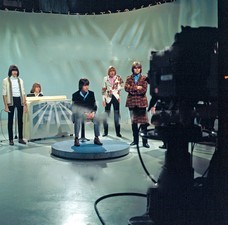
Filmed: Tuesday 15 August 1967
Location: Manchester, England
Broadcast: Tuesday 15 August, 1967, BBC 1, UK at 18.25
Release status: This programme has not been included on any officially released video or DVD
Shown in: UK
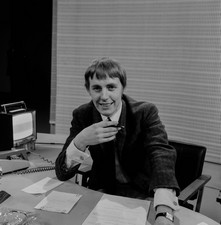
Hosted by British television interviewer and radio disc jockey, Simon Dee, this was a twice-weekly early evening BBC TV chat show.
On this show, according to a search on the BBC Radio Times listing archive, this episode featured the following guests:
Richard Murdoch (actor)
Donald Houston (actor)
Margaret Lockwood (actress)
Paul Jones (singer from Manfred Mann)
Millie Scott
The New Christy Minstrels (folk music group)
The Hep Stars
Music
The Johnny Patrick Orchestra
Script, MICHAEL WALE and JOE STEEPLES NEIL SHAND
Design, Peter Mavius Direction, COLIN CHARMAN
Production, TERRY HENEBERY
The Hep Stars performed It’s Nice To Be Back (this song later got Swedish lyrics and was recorded as Min egen stad by Frida).
Their appearance had been arranged by Richard Reese-Edwards, who was eager to become their manager. In Carl Magnus Palm's book Benny’s Road To ABBA, he explains how it all happened:
Still, The Hep Stars’ dreams of an international breakthrough were stronger than ever at that time, with the West German tours fresh in their memories and the plans for a US career in full swing. Coincidentally, during the Gothenburg visit, the group held a press conference introducing their new company, Hep Stars America, Inc. They also stated that there were plans for a three month autumn tour on the other side of the Atlantic.
In other words, there was still a feeling that world lay wide open for the group, and so it might be a good idea to hire someone who could help them with their career in England. So far, Åke Gerhard hadn’t been able to achieve a breakthrough on that market, and they had no other representative on the British Isles. Svenne and Richard sat and talked all night, and by the early hours of the morning they had agreed that Richard should start working for them. But not everyone in the band were so enchanted by that thought. ”When Svenne told Benny about it, he was not happy with that.” Richard Reese-Edwards recalls. ”He was very firm, but Svenne was also stubborn so Benny gave me a test. ’You put us on any television programme that we want in the world within three weeks and you can have the management.’ So I told him just to choose one. ’We want to go on Dee Time in Britain.’ ’Right,’ I said, and then we shook hands on that.”
At the time, Dee Time was one of the most popular entertainment shows on British television, hosted by Simon Dee. To secure an appearance on the show was no mean feat, and would be virtually impossible for an unknown band from Sweden. The Dee Time producer was completely uninterested in Richard Reese-Edwards’ proposal, but the young man just refused to let go.”By a campaign of more or less harrassment of the man, by ringing him persistently, get other people to ring him, turning up wherever he was day and night for a week, I finally got him to break down and give in and allow the band to go on the show. ’But if you don’t get a work permit for them, I’ll strangle you myself, because I had to move somebody else to get your band on the show. If you let me down, you’ll never do television with any of your bands ever again.’”
The British Musician’s Union initially refused the group a work permit, but after further persistent nagging, Reese-Edwards actually managed to accomplish what he’d set out to do. Not many of the Hep Stars members had counted on this outcome: they thought that the energetic Englishman was just another of the many suspect characters that came in their way. ”But Svenne insisted that the band make good on their commitment to appoint me as their manager, which they did.” Svenne confirms: ”I really believed in him.”
However, recollections differ as to the extent of Richard Reese-Edwards’ authority at the time. According to Reese-Edwards himself, he simply took over from Åke Gerhard and had the main responsibility for the group’s future career. Others claim that he was only in charge of the attempts to achieve a break in England. In a way it was the first time that The Hep Stars had a true manager; Åke Gerhard’s Europa-Produktion were mainly handling practical details concerning tour bookings and record releases. The career planning was mostly handled by the group themselves, primarily Felle Fernholm. Either way, Åke had no high opinion of Richard Reese-Edwards. ”He tried to drive a wedge in and push me out of the nest. But there was no reason for him to do that, which I believe I told him.”
Åke was part of the entourage when The Hep Stars flew to Manchester to appear on Dee Time in August 1967. Richard Reese-Edwards had made an effort to create as much attention as possible for the visit, but this didn’t impress Åke very much either. ”He had arranged for some girls to come up with some big flower arrangements wrapped in plastic when the boys got off the plane. I mean, if The Hep Stars had been well-known there would have been photographers there to take pictures, but they were completely unknown so of course there was nobody there. That was a bit childish.” The only photographer present was the group’s own friend, Ulf Holmstedt. His pictures show a group who, completely undisturbed and with slightly confused looks on their faces, come walking with big flower bouquets in an otherwise deserted airport.
On Dee Time, The Hep Stars were in good company. The show featured then big names such as The New Christy Minstrels and ex-Manfred Mann singer Paul Jones, as well as a filmed appearance by José Feliciano. The guys were mightily impressed and really felt that they were playing with the big boys. The song they performed in the show was entitled ’It’s Nice To Be Back’, written by Benny and released as the B-side of the ’Malaika’ single. The greeting on the airport may have been staged, but after the television broadcast the group was astonished to be accosted by a large group of fans outside the studio. ”The other acts – Paul Jones, for instance – were able to just walk past them undisturbed, but they were mad for us,” Svenne Hedlund recalls. ”They had been watching the show and ran down afterwards. They were ready with their autograph pads.”
Otherwise, however, the strategy concerning The Hep Stars’ UK launch was somewhat lacking in foresight and long-term planning. To begin with, the choice of song to perform in the show was wrong. ”I remember that Richard really liked ’Sunny Girl’, but at the time he was especially fond of ’It’s Nice To Be Back’,” says Svenne. ”It was his choice that we should perform that song on Dee Time. In hindsight I can’t understand that: we should have done a fabulous song such as ’Sunny Girl’. But you didn’t reason like that in those days, you had to pick the latest song. ’Sunny Girl’ was already an ’oldie’ by then – a whole year had passed!” No single release of ’It’s Nice To Be Back’ was on the cards in Great Britain at the time, and when the show was broadcast no Hep Stars records at all were available on the British market. Therefore, the effect of the television appearance was virtually nil. However, it was undoubtedly a triumph for Richard Reese-Edwards to get the group on Dee Time in the first place. It strengthened his resolve, and he had big plans for the international launch of the band.
Thanks to David Calverley and Carl Magnus Palm